
Ransomware has become the most popular weapon in the contemporary network space, which is constantly turning its attention to organizations and critical infrastructure.
With constant changes in cyber threats and with motivation, means and opportunities for cyberattacks strengthening continuously, the need for integrated approaches to counteract threats has never been greater, which may include technical, organizational and legislative tools to protect valuable data and systems.
Technical Measures
One of the greatest weapons against ransomware is the daily patching and updating of all the software and the systems by plugging up the loopholes used by attackers.
Further, anti-ransomware software should also be adopted while backup solutions should be protected to detect the potential issues early to avoid paying ransoms whenever data that is crucial should be recovered.
Organizational Measures
Companies should invest in training to ensure the employees can identify such attacks.
The proper setup of the Incident Response Plan (IRP) acts as a roadmap that must be implemented for it to help organizations contain and recover from an attack (Razaulla et al., 2023).
Several drills and simulations can make the organization ready and can minimize response time.
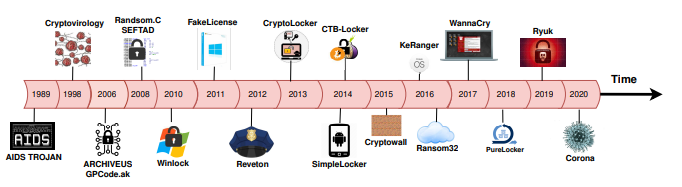
Figure 1: Evolution of Major Ransomware Families from 1989 to 2020 (Source: Oz et al., 2022)
Policy and Legal Responses
There are two major ways in which governments are involved in preventing ransomware: They champion no-pay ransom policies, which help discourage attackers from launching ransomware activities and they support collaboration on the global level as the tracking and arresting of cybercriminals requires international cooperation (Akibis et al., 2024).
Policies that require organizations to arrive at good cybersecurity postures and to report ransomware attacks also improve the situation for all.
Conclusion
Ransomware is a virus designed to encrypt files, documents and systems forcing the owners of these assets to pay a specified sum of money.
Its role has emerged more prominently in recent years, seen in the attack against Colonial Pipeline, Kaseya and the earlier NHS WannaCry attack.
Ransomware can be fought and stopped by those technical efforts; the updates, anti-ransomware software and backup solutions, as well as the organizational steps like the training of the employees and the implementation of an incident response plan.
More so, governments are supposed to undertake some measures such as no-pay ransom positions and enhanced global partnership.
Essential measures to contain future threats are to set new cybersecurity prospects as ransomware threats are expected to escalate and become more complex and numerous.
